Call us 8:00am - 8:00pm
079-2273 3345 / 6353949804
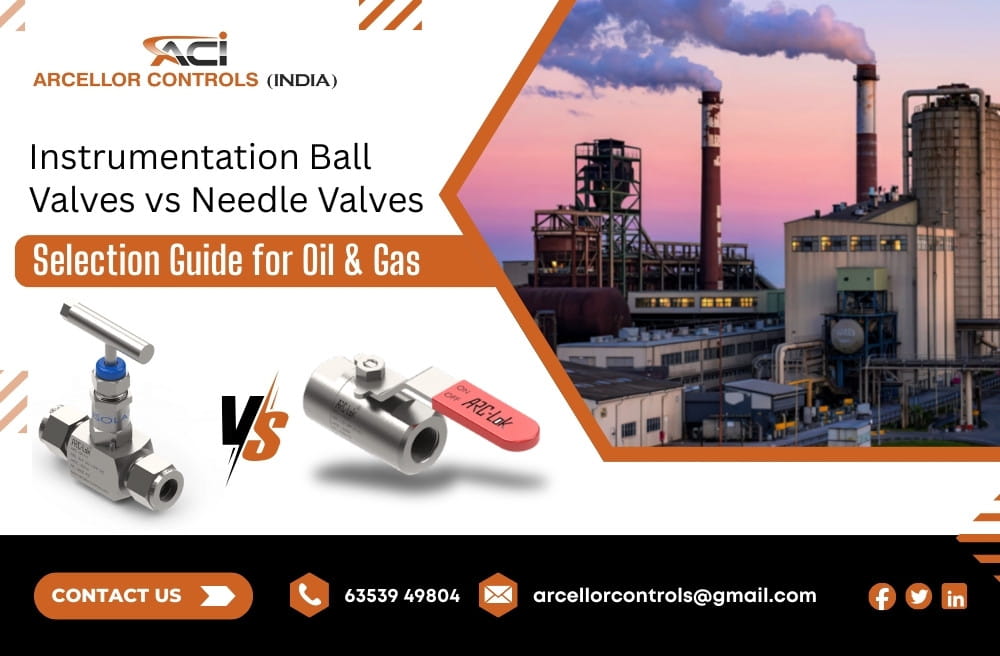
Instrumentation Ball Valves vs Needle Valves: Selection Guide for Oil & Gas
In the oil and gas industry, the choice of valve directly affects operational safety, efficiency, and long-term stability. When it comes to upstream exploration and midstream transportation, and downstream refinery, selecting the correct valve will ensure exact management of the flow as well as leak prevention in extreme temperatures and pressures.
One of the two frequently utilized instruments that Indian industries depend on includes ball valves and needle valves. Both play a vital role in process systems; their functions and application differs significantly. This guide, presented by us at Arcellorcontrols, a top needle valve manufacturer in India, will explain the major distinctions, benefits, and criteria for selection to assist procurement and engineering teams in making the right choice.
Understanding the Instrumentation Valves within Oil & Gas
Instrumentation valves are precisely engineered parts that are used for regulating, isolating, and controlling the flow of gases and fluids inside process equipment. In oil and gas installations, they are usually employed in the following areas:
- Lines for pressure measurement
- Systems for flow instrumentation
- Chemical injection systems
- Systems for pneumatic and hydraulic systems
- Sampling systems
The high-end instrumentation valves India manufactures are made to resist corrosive media, high pressures, corrosive media, and dangerous environments.
What are the Instrumentation Ball Valves?
Ball valves make use of rotating spherical balls with a bore in their center, allowing them to regulate the flow. If the bore is aligned to the pipe, flow is permitted. If the bore is rotated 90 degrees, the flow is stopped.
Important Characteristics of Ball Valves
- Quarter-turn operation
- Ability to shut off the power quickly
- Minimal pressure drop
- Excellent sealing performance
- Available in trunnion and floating designs.
Benefits in Oil & Gas Applications
- Speedy Operation, Perfect for emergency shut-offs.
- high pressure handling is ideal for drilling upstream or transmission lines.
- Lasting: Long service life under extreme operating conditions.
- Easy Maintenance: A simple mechanism that reduces damage and wear.
Ball valves are extensively employed as isolation valves in control valves for processes in which complete off and on functionality is required.
What are Needle Valves?
Needle valves come with a long, tapered needle stem that is precisely fitted into the seat. This design permits the gradual and precise management of the flow.
The Key features of Needle Valves
- Fine flow regulation
- Multi-turn operation
- High-precision control
- Compact design
- Great throttle performance
Leading manufacturers of needle valves develop these valves to meet the demands of applications that require extremely precise flow adjustments.
Benefits of Oil & Gas Applications
- Precise Flow Control: Perfect for instrumentation and calibration panels.
- Pressure Regulation: Excellent for pressure gauge isolation.
- Preventing leaks Sealing tight for pipelines with small diameters.
- The Controlled Flow Rate is ideal for chemical injection and gas sampling.
Needle valves are crucial in systems where gradual control is more crucial than quick shut-off.
Ball Valves vs Needle Valves: The Key Differences
| The Feature | Ball Valves | Needle Valves |
| Operation Type | Quarter-turn | Multi-turn |
| Primary Role | On/Off Isolation | Control of Flow |
| Control of Flow | Limited throttle | Precise control |
| Pressure Drop | Minimal | a little higher |
| Best Use Case | Emergency shut-off | Instrument calibration |
| Maintenance | Low | Moderate |
Knowing the differences can help engineers choose the best valves for process control to meet their particular system needs.
Evaluation Criteria For Oil & Gas Applications
In deciding between needle and ball valves, take into account these factors:
1. Nature of Application
- To shut off the entire system, for complete shut-off: Ball valve
- To regulate, gradual circulation: Needle valve
2. Rates of Temperature, Pressure, and Pressure
Gas and oil operations typically require extreme conditions. Make sure the material used for valves (SS 316, Duplex, etc.) is in compliance with the standards.
3. Fluid Type
Hydrocarbons, corrosive chemicals, and gas require corrosion-resistant materials provided by reliable instrumentation valves that India manufactures.
4. Requirements for Accuracy of Flow
If your system requires micrometer-level control, needle valves will be the ideal option.
5. Safety Compliance
Valves need to meet international standards such as API, ASME, and ISO for use in hazardous environments.
Applications in the Oil & Gas Industry
Where Ball Valves are preferred
- Wellhead isolation
- Pipeline shut-off
- Emergency valves to block the flow of water
- Gas distribution systems
When Needle Valves Are Ideally Suitable
- Pressure gauge isolation
- Connections to flow meters
- Sampling systems
- Hydraulic instrumentation panels
Many integrated systems utilize both kinds of technology to provide maximum performance and safety.
What is the reason? Quality Manufacturing Matters
In the field of oil and gas, valve failure could result in massive losses. Partnering with a reliable needle valve manufacturer and experienced suppliers of process control valves assures:
- Precision machine
- High-grade raw materials
- Strict quality control testing
- Long-lasting operational life
- Conformity to global standards
Arcellorcontrols offers robust solutions that are specifically tailored to the most demanding oil and gas applications. We offer instruments with high performance that Indian customers rely on for their safety and effectiveness.
Maintenance Tips
Even valves of the highest quality require periodic examination. Preventive maintenance comprises:
- Inspection of leaks
- Lubrication of the stem
- Seal replacement
- Torque testing
- Testing for pressure
A regular maintenance schedule prolongs the service life and ensures that the system performs at a consistent level.
Ball valves for instrumentation and needle valves are essential components in the oil and gas system. The final decision is based on the specific application and whether it needs a quick shut-off as well as precise flow controls.
In the case of isolation and emergency shut-off, ball valves are the best option. To calibrate, throttle, and precisely control instruments, needle valves offer the best performance.
Choosing the most suitable instrument valves India supplier guarantees security, reliability, and long-term savings. By analyzing the requirements for operation and deciding on the most efficient system control valves for the process, oil and gas operators can dramatically improve the efficiency of their system and minimize the amount of downtime.
Arcellorcontrols a leading manufacturer of needle valves in India, continues to assist the industry with a range of high-tech solutions that are designed to meet the most challenging environments.
1. What is the main difference between instrumentation Ball valves and needle valves?
Ball valves for instrumentation are typically used to control on/off isolators using quarter-turn operation. Similarly, needle valves offer precise flow control by using a multi-turn mechanism.
2. The best time to select needle valves to manufacture products for gas and oil applications?
Select needle valves when precise flow control or pressure control instrument calibration is required for high-pressure systems.
3. Are ball valves suited for control valves used in process systems?
Yes, ball valves are extensively employed in control systems for process control to isolate and for emergency shut-off.
4. What are the reasons that instrumentation valves India manufacturers are crucial for oil and gas projects?
Trustworthy instrumentation valves India manufacturers provide high-quality products in line with industry standards and endurance under the most demanding operating conditions.
5. Which valve is best for high-pressure gas and oil pipelines?
Ball valves are usually preferred for isolation of pipelines with high pressure, while needle valves are best suited for precise flow and pressure control in instrument lines.
Get in Touch
You will find yourself working in a true partnership that results in an incredible experience, and an end product that is the best.



Post A Comment